3D experiences that earn the scroll.
Interactive Three.js scenes and product visualizations that turn passive viewers into engaged users, without killing their battery.
- Starting from
- $14,000
- Typical timeline
- 6–10 weeks
- Performance target
- 60fps
- Scene budget
- < 3 MB
- Device support
- All
- Three.js
- GLSL
- GSAP
- Lenis
- WebGPU
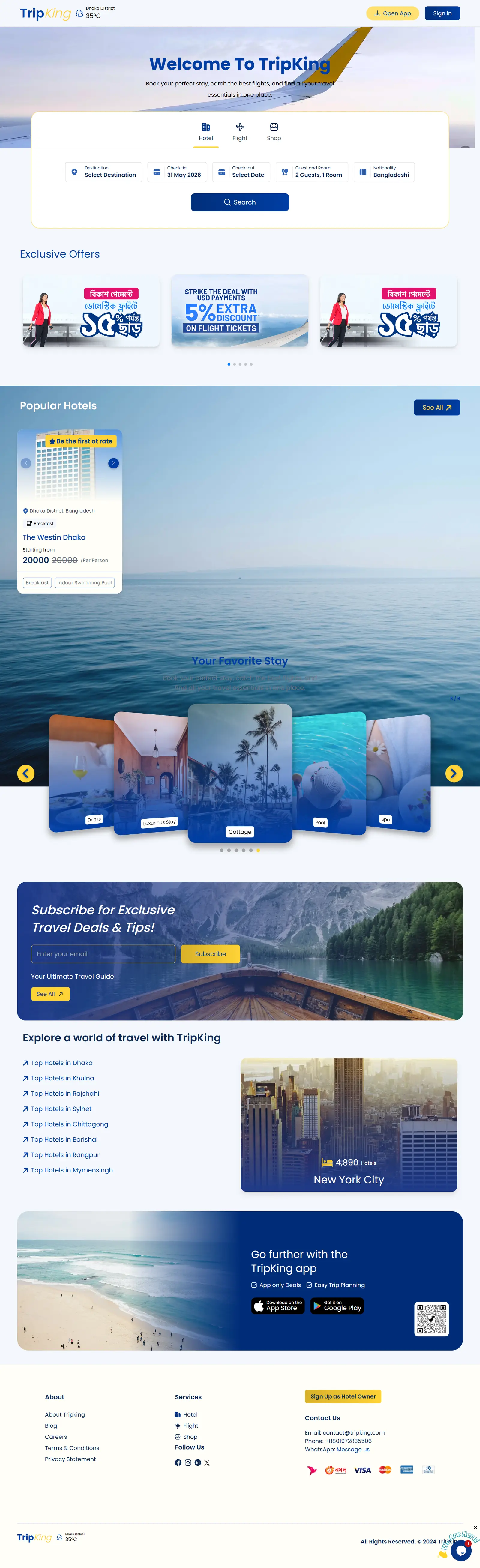 TripKingTravel · E-commerce
The web is flat. Until it isn't. The studios and products that stand out in 2025 are the ones that treat the browser as a canvas, not a document.
We build Three.js experiences that run at 60fps on a MacBook Air and degrade gracefully on a three-year-old Android. Performance is not an afterthought. It is a design constraint. Every scene starts with a draw call budget and a texture compression target.
WebGL is not just for portfolios. Product visualizations, immersive onboarding, data storytelling, interactive configurators. These are conversion tools. We help you figure out whether 3D will move your metric, and only then do we write the first shader.
"The best WebGL experience is the one the user doesn't know is WebGL. They just know they couldn't stop scrolling."
Every deliverable. No ambiguity.
8 things you own at the end of the engagement, written into the proposal before work starts.
- 01
Three.js scene
Self-contained, embeddable React component with full source code and documentation.
- 02
3D assets
GLB/GLTF models with Draco compression, optimized to < 3 MB total scene budget.
- 03
Custom shaders
GLSL vertex and fragment shaders for custom visual effects, documented and transferable.
- 04
Scroll interaction
Lenis smooth scroll with GSAP ScrollTrigger or custom RAF-based scroll linking.
- 05
Performance report
FPS and memory profiling across mobile, tablet, and desktop with optimization log.
- 06
Graceful fallback
Static image fallback for devices that cannot run WebGL: zero broken experiences.
- 07
Source code
Fully documented Three.js code with setup guide and extension notes.
- 08
CMS integration
Optional: CMS-controlled scene parameters so your team can iterate without code.
- Three.js
- GLSL
- GSAP
- Lenis
- WebGPU
- Blender
- Draco
- KTX2
- React Three Fiber
- Vite
- Spline
- Rive
A repeatable process. No surprises.
6–10 weeksfrom kickoff to launch, with a demo at the end of every sprint.
- 01
Concept & Storyboard
Define the narrative arc, interaction moments, and technical scope. We build a performance brief before any assets are created.
1 wk - 02
3D Asset Creation
Model, texture, and rig assets in Blender with a performance budget in mind. Draco compression and KTX2 textures from the start.
2–3 wks - 03
Scene Development
Three.js scene with custom lighting, post-processing pipeline, and scroll-linked interaction. Every frame earns its place.
2–4 wks - 04
Performance Optimization
Texture atlasing, instanced meshes, draw call reduction, and frame rate testing across 30+ real devices. We ship when it's smooth.
1 wk - 05
Integration & Launch
Embed into your Next.js or any web stack. Cross-browser tested, static image fallback for WebGL-unsupported contexts.
1 wk
Most agencies do this. We do the opposite.
Fixed scope, fixed price, senior people, and four promises that make this a safe yes.
Let’s answer the obvious ones first.
Direct answers to what every prospect asks before our first call. If yours isn’t here, ask us.
Ask your own questionHow fast can you actually start?
Most projects kick off within 1–2 weeks of the discovery call. We accept a maximum of 2 new engagements per quarter so the team you meet is the team that ships your work. No bait-and-switch.
How is payment structured?
50% to start, 25% at the mid-point demo, 25% at launch. We use Stripe invoices, in USD. For $14,000+ engagements we can split into monthly retainers if it fits your runway better.
What if scope changes mid-project?
It will. We re-scope in writing the moment something material shifts. You decide whether to extend the timeline, raise the budget, or trim. No silent meter running. No surprise invoices.
Do you sign NDAs and work in our repo?
Yes to both. We sign your NDA before the discovery call if needed, work directly in your GitHub/GitLab, follow your branching conventions, and join your Slack and stand-ups.
What happens after the project ships?
You get 30 days of included bug fixes and minor iterations. After that, we offer a flat-rate maintenance retainer or you can take it fully in-house. Your code, your call. No vendor lock-in.
Can you work with our existing team?
That is most of what we do. We embed alongside your engineers, hand off cleanly, document everything, and pair on the parts your team wants to own going forward.
Pair this with another discipline.
- 01Web DevelopmentNext.js, TypeScript, edge-first stacks. Performance-obsessed.
- 02Mobile AppsNative iOS/Android and React Native. Shipped to the store.
- 03UI / UX DesignResearch, wireframes, and high-fidelity design systems.
- 04Brand & MotionIdentity, visual systems, and motion principles that scale.
- 06E-CommerceShopify Plus, custom headless storefronts, and Stripe flows.
Ready to build something worth using?
Tell us about your project. We reply within 24 hours with an honest assessment and a rough scope. No sales pressure.
Prefer email? hello@codeflee.com · WhatsApp
